Choosing the right ERP platform is one of the most significant technology decisions an organisation will make. It influences financial management, manufacturing, procurement, reporting and operational efficiency for years to come.
Microsoft offers two powerful cloud ERP platforms: Dynamics 365 Business Central and Dynamics 365 Finance and Supply Chain Management. Because both are part of the Dynamics 365 family and share Microsoft's cloud ecosystem, many organisations assume Finance and Supply Chain Management is simply the larger, more capable version of Business Central.
The reality is more nuanced.
Both solutions provide excellent ERP functionality, but they have been designed for organisations with very different operational requirements. While Dynamics 365 Finance and Supply Chain Management delivers extensive enterprise capabilities, many medium-sized organisations discover they are paying for complexity they neither need nor fully utilise. Conversely, organisations with global operations and sophisticated supply chains may quickly outgrow the capabilities of Business Central.
This guide compares both platforms from a business perspective, helping you determine which solution offers the greatest long-term value.
Why Microsoft Offers Two ERP Platforms
Unlike many ERP vendors that attempt to serve every organisation with a single product, Microsoft has developed two platforms to address different areas of the market.
Business Central is aimed at small and medium-sized organisations looking for an integrated solution that combines finance, operations, inventory, manufacturing and reporting without unnecessary complexity. It focuses on delivering best-practice business processes that can be implemented quickly and managed without a large internal IT team.
Dynamics 365 Finance and Supply Chain Management serves a different audience. It has been built for organisations operating across multiple countries, legal entities and business units, where advanced governance, compliance and operational control become essential. Rather than simplifying business processes, it provides the flexibility required to manage highly complex global operations.
Understanding this distinction is more important than comparing feature lists. The objective is not to buy the ERP with the most functionality, but the one that aligns most closely with the way your organisation operates.
Business Central vs Finance and Supply Chain at a Glance
| Area | Business Central | Finance & Supply Chain Management |
|---|---|---|
| Target organisation | Small and medium businesses | Large enterprises |
| Typical users | 20–500 | 500–10,000+ |
| Operational complexity | Moderate | High |
| Manufacturing | Comprehensive | Advanced enterprise |
| Warehouse management | Standard | Enterprise WMS |
| International operations | Good | Excellent |
| Implementation | Faster | Longer |
| Total cost of ownership | Lower | Higher |
Although the table highlights some clear differences, it is worth noting how much functionality the two systems actually share. Both provide comprehensive finance, purchasing, inventory, manufacturing and reporting capabilities. The real distinction lies in the scale and complexity of the organisations they are designed to support.
Core ERP Functionality: More Similar Than Many Organisations Realise
One of the biggest misconceptions surrounding Business Central is that it is a limited ERP solution. In reality, it includes the core functionality most organisations rely on every day.
| Function | Business Central | Finance & Supply Chain Management |
| Financial management | ✓ | ✓ |
| Purchasing | ✓ | ✓ |
| Sales order management | ✓ | ✓ |
| Inventory management | ✓ | ✓ |
| Manufacturing | ✓ | ✓ |
| Project management | ✓ | ✓ |
| Microsoft Copilot | ✓ | ✓ |
| Power BI integration | ✓ | ✓ |
For finance teams, procurement departments and operations managers, day-to-day processes look remarkably similar regardless of which platform they use.
Both solutions automate financial processes, improve reporting and integrate seamlessly with Microsoft 365.
The differences only begin to emerge as organisations become more operationally complex. Businesses managing multiple legal entities across different countries, highly regulated industries or sophisticated global supply chains often require functionality that extends beyond the needs of a typical medium-sized organisation.
Finance Capabilities
Both platforms provide robust financial management, but they have been designed with different levels of complexity in mind.
Business Central delivers comprehensive accounting capabilities, including general ledger, accounts payable, accounts receivable, budgeting, fixed assets, cash management and multicurrency support.
When combined with dimensions, financial reporting, and Power BI dashboards, it provides the functionality most finance departments require to manage business performance effectively.
Dynamics 365 Finance builds on these foundations by introducing enterprise financial management capabilities. Organisations can manage multiple legal entities from a shared environment, automate intercompany accounting, consolidate financial data across global subsidiaries and meet complex international regulatory requirements.
For multinational enterprises, these capabilities are invaluable. However, organisations operating primarily within the UK rarely require this level of financial sophistication. Introducing enterprise accounting functionality where it is not needed often increases implementation effort, administration and user training without delivering proportional business value.

Manufacturing: Capability Versus Complexity
Manufacturing is one of the areas where buyers often assume they need the enterprise platform. In practice, this is rarely the case.
| Manufacturing Capability | Business Central | Finance & Supply Chain Management |
| Bills of Materials | ✓ | ✓ |
| Routings | ✓ | ✓ |
| Production Orders | ✓ | ✓ |
| Material Requirements Planning | ✓ | ✓ |
| Capacity Planning | ✓ | ✓ |
| Process Manufacturing | Limited | Advanced |
| Lean Manufacturing | Limited | ✓ |
| Advanced Production Scheduling | Standard | Advanced |
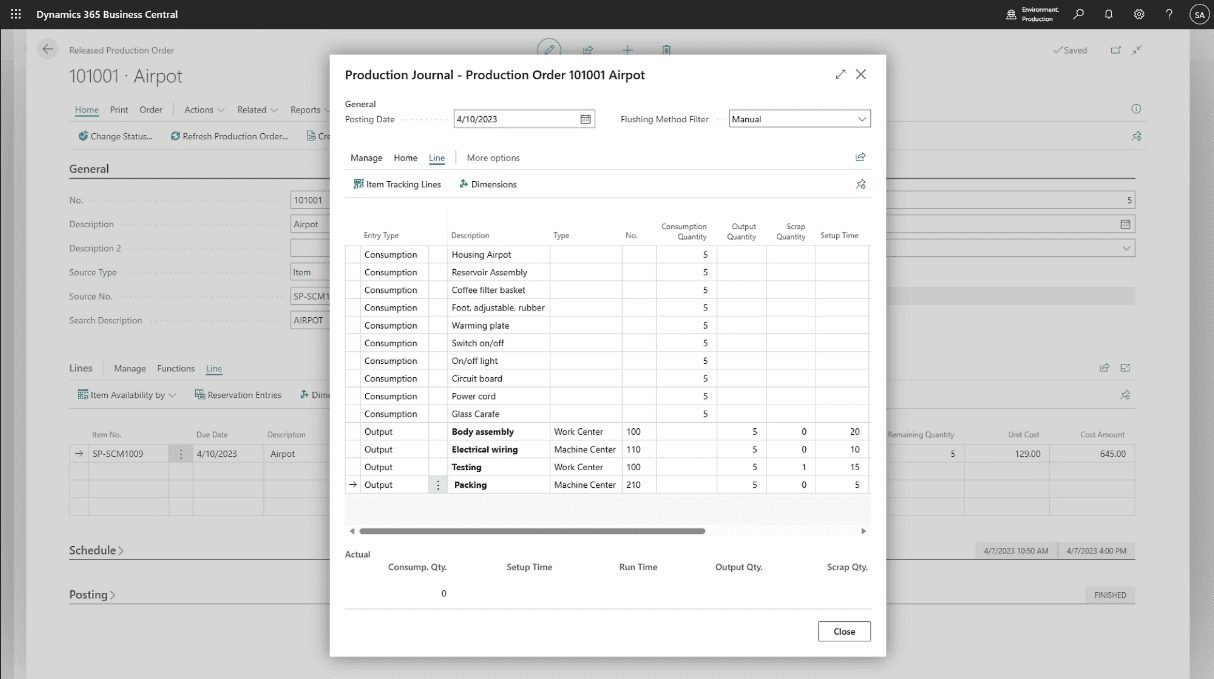
Business Central supports the manufacturing processes used by the majority of UK manufacturers. Production orders, bills of materials, routings, material requirements planning and capacity planning are all included as standard, enabling manufacturers to improve production efficiency, reduce waste and manage inventory effectively.
Dynamics 365 Supply Chain Management introduces more sophisticated manufacturing capabilities, including process manufacturing, advanced production scheduling and enterprise planning across multiple production sites. These features are particularly valuable for multinational manufacturers operating complex production environments, but they can be excessive for organisations with more straightforward manufacturing operations.
For many medium-sized manufacturers, Business Central delivers the right balance between capability and usability. Rather than overwhelming users with enterprise functionality, it focuses on helping organisations improve operational efficiency using proven manufacturing processes.
Supply Chain and Warehouse Management
Supply chain management is another area where Finance and Supply Chain Management extends beyond the capabilities of Business Central.
Business Central provides robust purchasing, inventory management, replenishment planning and warehouse functionality suitable for manufacturers, distributors and wholesalers.
Finance and Supply Chain Management builds upon this foundation with advanced transportation management, supplier collaboration, AI-driven demand planning and enterprise warehouse management.
| Warehouse Capability | Business Central | Finance & Supply Chain Management |
| Multiple warehouses | ✓ | ✓ |
| Bin management | ✓ | ✓ |
| Lot and serial tracking | ✓ | ✓ |
| Warehouse picks and put-aways | ✓ | ✓ |
| RF scanners | Limited | ✓ |
| Wave planning | — | ✓ |
| Cross-docking | — | ✓ |
| Yard management | — | ✓ |
These enterprise warehouse capabilities are undoubtedly impressive, particularly for organisations operating automated distribution centres or international logistics networks. However, many medium-sized organisations simply do not require this level of sophistication. In these cases, the additional complexity can increase implementation costs and administration without delivering meaningful operational improvements.
Business Central vs Dynamics 365 Finance and Supply Chain Management: Choosing The Right ERP Solution
Both Business Central and Dynamics 365 Finance and Supply Chain Management are market-leading ERP solutions, but they have been designed to solve different business challenges.
Dynamics 365 Finance and Supply Chain Management is an exceptional platform for large enterprises operating across multiple countries, managing complex supply chains and requiring advanced financial governance. Its extensive functionality provides the flexibility and control needed to support global operations, but that sophistication comes with increased implementation effort, administration and cost.
Business Central, on the other hand, is purpose-built for growing and medium-sized organisations. It delivers comprehensive finance, manufacturing, supply chain and operational capabilities without introducing unnecessary complexity. For many organisations, it provides everything required to modernise business processes, improve visibility and support future growth while remaining quicker to implement, easier to manage and more cost-effective over the long term.
Ultimately, selecting the right ERP should never be about choosing the platform with the longest feature list. Instead, it should be about selecting the solution that best aligns with your organisation's operational requirements, growth plans and available resources. For the majority of medium-sized businesses, Business Central offers the ideal balance of functionality, usability and value, while organisations with genuinely enterprise-scale complexity will benefit from the additional capabilities of Dynamics 365 Finance and Supply Chain Management.