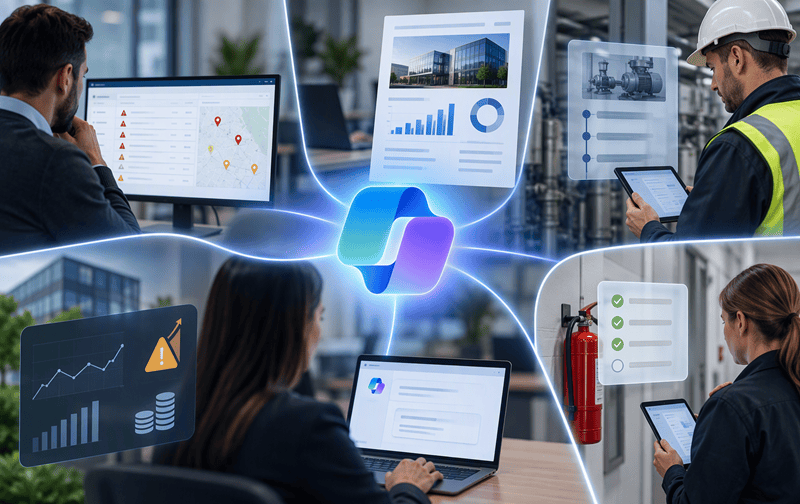
There's a an operational irony that plays out in utilities businesses every day. Engineers are monitoring smart meters and grid sensors that generate millions of data points an hour. Yet the scheduling decision for the technician responding to that sensor alert is still being made on a spreadsheet.
The data is intelligent. The systems around it are not.
This is not a technology gap so much as an integration gap. Most utility providers have invested in pockets of digital capability — IoT devices, modern billing platforms, customer portals — but the underlying business systems that connect finance, field operations, asset management and customer service were often built for a simpler operating environment. They were not designed for distributed energy resources, accelerating net zero commitments, or customers who expect the same responsiveness from their water supplier as they get from their bank.
The question facing utility leaders is not whether to modernise. That decision is largely made for them by regulatory pressure, infrastructure age, and competitive necessity. The real question is how to modernise in a way that compounds value across the business rather than adding yet another siloed system to an already fragmented landscape.
Microsoft's ERP and industrial AI ecosystem — built around Dynamics 365, Azure IoT, Power BI and Copilot — offers utilities a path to genuine operational unification. This article evaluates what that looks like in practice, and what future-ready operations need to deliver.
The Cost of the Integration Gap
The utilities sector faces a convergence of pressures that legacy systems were not built to absorb. Renewable energy investment grew by 30% in a single year, driven by the accelerating energy transition and increasing investor focus on sustainable generation. Distributed energy resources — solar panels, electric vehicle charging, battery storage — are pushing traditional operational technology environments to their limits and forcing grid operators to rethink how they manage supply and demand in real time.
At the same time, 61% of utilities executives believe that infrastructure investment should prioritise flexibility for energy system resilience. Customers now expect transparent communication, proactive outage updates, and digital self-service as standard — expectations increasingly shaped by experiences with digital-first industries entirely outside the utilities sector.
None of these challenges can be addressed system by system. The response to a grid fault is not a field operations problem or a customer service problem or a finance problem — it is all three simultaneously. When the systems handling each of those functions cannot share data in real time, the business is slower, more expensive to run, and harder to manage at the leadership level.
The integration gap is where operational cost accumulates and where customer trust erodes.
Why AI Must Be Embedded, Not Added
Industrial AI has attracted significant attention across the energy sector, and for good reason. Its applications in utilities are broad and material: predictive maintenance, load forecasting, intelligent field dispatch, cybersecurity monitoring across converged IT and OT environments, and automated regulatory reporting.
But there is a critical distinction between AI that is embedded in operational systems and AI that is bolted on as a standalone capability. The former changes how decisions are made across the business. The latter adds another tool that requires separate data inputs, separate training, and separate management.
A McKinsey study published in early 2025 found that 92% of companies plan to increase AI investment over the next three years, yet only 1% consider their AI deployment mature. The same research found that frontline employees are already using AI for more than 30% of their work — three times more than their leaders estimate. [McKinsey & Company, Superagency in the Workplace, January 2025] The implication for utilities is significant: AI adoption is not waiting for a strategic green light. It is happening at the operational level, in informal and often disconnected ways, without the governance or data infrastructure to make it reliable.
The strategic priority is not to accelerate AI adoption. It is to provide a platform in which AI can function as a consistent, governed, and integrated capability — one that draws on unified data rather than fragmented sources, and one that surfaces insight at the point where decisions are actually made.u
Microsoft Dynamics 365: ERP Architecture Built for Utilities Complexity
Dynamics 365 provides the operational backbone that makes embedded AI viable in a utilities context. Rather than connecting multiple specialist systems through expensive integrations, it unifies the core business functions — asset management, field operations, finance, customer service, and reporting — within a single platform. The strategic value is not any individual module but the compounding effect of having those functions share a common data layer.
Asset and Infrastructure Management
Utilities operate capital-intensive, geographically dispersed asset bases — substations, pipelines, water treatment facilities, smart meters — that require continuous monitoring and structured maintenance programmes. Dynamics 365 supports full asset lifecycle management, integrating telemetry and sensor data to track performance in real time. Predictive analytics surface degradation patterns before they become failures, shifting maintenance from a reactive cost to a planned investment with measurable impact on uptime and infrastructure lifespan.
Field Operations and Workforce Management
Dynamics 365 Field Service brings AI-assisted scheduling and resource optimisation to the management of mobile workforces. Engineers are routed based on skills, location, and availability. Work orders are generated, assigned, and tracked digitally, with real-time updates on job status and SLA compliance. For utilities managing remote infrastructure across wide geographies, this transforms field operations from a coordination overhead into a controllable, measurable function.
Finance, Billing and Compliance
Business Central and Dynamics 365 Finance provide enterprise-wide financial management, including integration with or replacement of legacy billing systems. Meter data management, usage calculations, invoice generation, and automated payment reminders are handled within the same platform that manages operational budgets and capital expenditure. Regulatory reporting — a persistent overhead in a compliance-intensive sector — is supported through automated data capture and structured audit trails, reducing the manual effort and error risk that characterise spreadsheet-based approaches.
Customer Operations
Modern utility customers interact across multiple channels and expect resolution, not just acknowledgement. Dynamics 365 Customer Service supports multi-channel case management — phone, email, chat, and self-service portal — with AI-powered Copilot assistance helping service agents access relevant information faster. Proactive communication tools allow utilities to notify customers of planned outages or service updates before they raise queries, shifting the customer experience from reactive to managed.
Unified Reporting and Decision Intelligence
Power BI connects operational, financial, and customer data into executive dashboards that provide real-time visibility without manual reconciliation across systems. Leaders can monitor asset performance, field productivity, regulatory compliance, and customer satisfaction metrics from a single environment — enabling faster and better-informed decisions at every level of the organisation.
IT/OT Convergence: Closing the Most Dangerous Gap
One of the most significant structural vulnerabilities in utility operations is the separation between IT — the business systems managing finance, customers and workforce — and OT, the operational technology controlling physical infrastructure. These environments have traditionally been managed independently, with limited data exchange and different security postures.
The growth of distributed energy resources and the increasing connectivity of grid infrastructure is making that separation untenable. Microsoft's adaptive cloud approach addresses this directly, integrating on-premises control systems and edge intelligence with cloud-scale analytics through Azure IoT and Azure Arc.
The practical effect is that operational data from physical infrastructure — sensor readings, equipment performance, grid conditions — becomes available within the same analytical environment as business data. Maintenance decisions can be informed by real-time asset telemetry. Financial planning can reflect actual infrastructure condition rather than scheduled assumptions. Security monitoring can span both domains, reducing the attack surface that converged IT/OT environments create.
Uniper, the world's largest power generation company, used this approach to standardise IT and OT management across all applications, enabling faster service delivery and improved performance consistency. The adaptive cloud model is not a theoretical architecture — it is a proven operational approach in environments of comparable complexity to most utility providers.
A Framework for Evaluating Operational Readiness
For utility leaders assessing their current position against future requirements, the following questions expose the most consequential gaps:
Data unification: Can leadership access a single, real-time view of operational, financial, and customer performance — or does that picture require manual assembly from multiple systems?
Predictive capability: Are maintenance and operational decisions driven by data and analytics, or primarily by schedules and reactive incident management?
Regulatory confidence: Can compliance data be produced accurately and efficiently, without significant manual effort or cross-team reconciliation?
Field efficiency: Is workforce scheduling informed by AI-assisted optimisation, or is it still largely manual and experience-dependent?
Customer experience: Can customers self-serve, receive proactive service updates, and resolve issues digitally without needing to contact a call centre?
IT/OT alignment: Are operational systems and business systems converging around shared data, or still operating in functionally separate environments?
Where the honest answer to most of these questions is no, the gap between current state and required capability is significant — and the cost of that gap is likely already visible in operational inefficiency, compliance risk, and customer satisfaction metrics.
From Platform to Capability: The Implementation Imperative
Technology selection is the starting point, not the outcome. The distance between deploying a platform and achieving operational transformation is determined by implementation quality, change management, and the degree to which the system is configured around the realities of the business rather than generic defaults.
Akita Intelligent Solutions is a certified Microsoft Solutions Partner with specific experience in delivering Dynamics 365 for utilities and energy organisations. Implementations are built around industry-specific workflows — smart meter management, predictive maintenance scheduling, multi-channel customer service, and regulatory reporting — rather than adapted from generic configurations. This reduces deployment time, lowers customisation cost, and accelerates the point at which the system delivers measurable operational value.
From initial consultancy and process mapping through to configuration, integration, end-user training, and ongoing support, Akita provides the full implementation lifecycle. Power BI reporting and Azure IoT integration are embedded from the outset, ensuring that the data and analytical capabilities that make the platform genuinely intelligent are available from day one rather than added as a later phase.
Building the Operating Model the Sector Now Demands
The energy transition is creating the most significant operational challenge utilities have faced in a generation. The infrastructure is changing. The customer relationship is changing. The regulatory environment is tightening. And the data available to run the business is growing faster than most organisations can productively use it.
The utility businesses that will manage this period most effectively are not necessarily those with the most advanced technology investments. They are the ones that have built coherent, integrated operating models — where asset data informs maintenance decisions, where field operations reflect customer commitments, where financial planning connects to physical infrastructure condition, and where leadership has the visibility to act on what the business is telling them in real time.
Microsoft Dynamics 365 and its surrounding AI and analytics ecosystem provide the platform to build that operating model. The starting point is an honest assessment of where integration gaps are costing the business most — and a clear view of what unified operations would make possible.
Akita Intelligent Solutions delivers Microsoft Dynamics 365 for utilities and energy companies across the UK. To discuss how ERP and AI can transform your operations, contact our team or visit our utilities and energy page.