
Manufacturers rarely fail to deliver because they don’t understand the importance of service or efficiency. They fail because the systems they rely on force them into compromises.
To protect customer delivery, they carry more stock than they want. For reducing inventory, they accept more exceptions, more expediting, and more customer dissatisfaction than feels acceptable.
Over time, this tension becomes normalised. Missed delivery dates are blamed on suppliers. Excess inventory is justified as a necessary buffer against uncertainty. Teams become highly skilled at firefighting, even though everyone recognises it is costly and unsustainable.
Addressing The Issue
In this situation, what often goes unchallenged is the root cause. Most planning and replenishment decisions are still made without a clear, shared, real‑time view of demand, supply, and operational constraints.
When visibility is limited, inventory becomes the default risk‑management tool.
Microsoft Dynamics 365 Business Central allows manufacturers to break this pattern. Not by encouraging them to carry more stock, but by enabling better decisions across sales, production, purchasing, and inventory — decisions that improve service levels while systematically reducing excess inventory.
Why Service And Inventory Problems Usually Come Together
In many manufacturing organisations, service level issues and excess inventory are treated as separate problems. One is handled by customer service or sales operations, the other by supply chain or finance.
But in reality, they are tightly connected.
Poor service levels typically show up as late deliveries, partial shipments, and constant changes to promised dates. Excess inventory shows up more quietly, as slow‑moving stock, growing warehouse space, and increasing write‑offs. Both stem from the same issue: planning is disconnected from reality.
When sales forecasts live in spreadsheets, reorder points are outdated, and production plans are adjusted manually, no one has a complete picture. Planners compensate by adding buffers. Purchasing orders “just in case.” Production schedules are padded to protect against shortages.
Each decision makes sense locally, but collectively they inflate inventory without reliably protecting service.
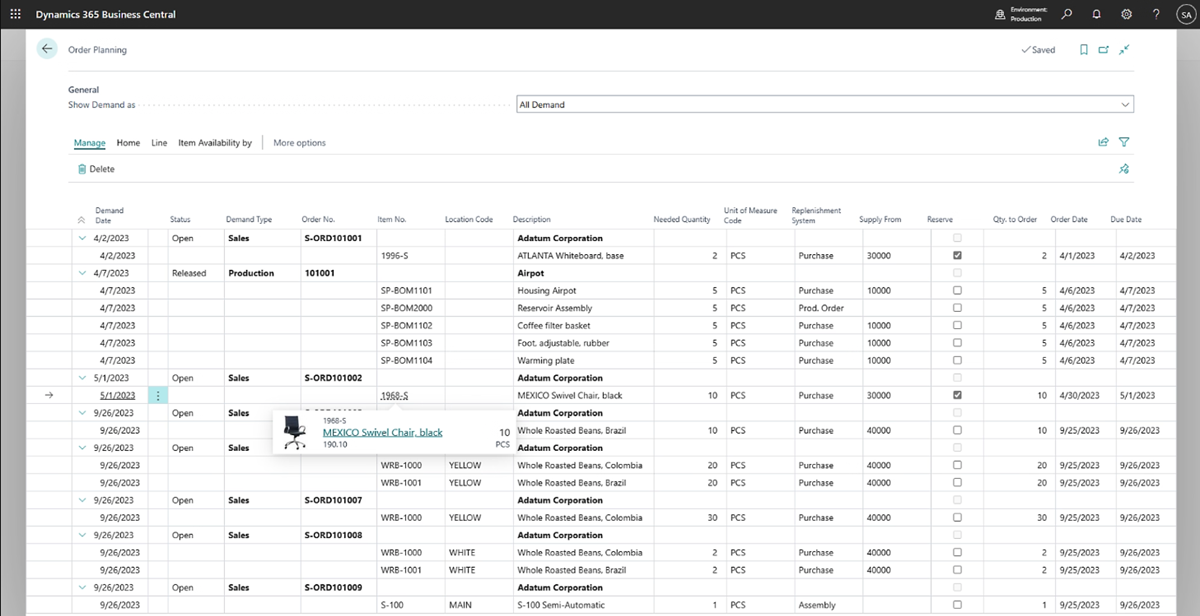
Business Central addresses this by bringing demand, supply, and execution into a single system. Inventory levels, sales orders, production orders, and purchase orders are visible in one place and updated in real time.
This shared view reduces uncertainty and allows manufacturers to replace blunt buffers with informed decisions.
From Fragmented Planning To A Single Source Of Truth
One of the most immediate changes manufacturers experience with Business Central is the shift from fragmented planning to a single source of truth.
Instead of reconciling multiple reports, planners can see current stock, future demand, and expected supply in one system. They can understand which items are genuinely constrained and which appear risky only because of outdated assumptions.
This clarity often reveals that inventory is unevenly distributed: too much in the wrong places, and not enough where it matters most.
When decisions are made from a consistent data set, conversations change. Sales understands what can realistically be promised. Production sees which orders truly require prioritisation. Purchasing aligns more closely with actual demand rather than historical habits. The result is fewer surprises and more deliberate trade‑offs.
This alignment alone often improves service performance, even before any inventory reduction initiative formally begins.
Demand Planning That Reflects Reality, Not Guesswork
Traditional forecasting approaches tend to lock manufacturers into static assumptions. Forecasts are updated infrequently, often manually, and rarely challenged once they are in place. When demand shifts, planners respond reactively, usually by increasing buffers.
Business Central supports demand planning that is more dynamic and transparent. Forecasts are based on historical sales data and can be adjusted as patterns emerge. More importantly, planners can see how forecasts interact with actual orders, current inventory, and future supply.
This makes it easier to distinguish between short‑term noise and genuine changes in demand. Instead of reacting to every fluctuation, manufacturers can adjust plans proportionately. Over time, this leads to better forecast accuracy and less reliance on excess inventory as insurance.
Because forecasts and actual demand live in the same system, discrepancies are visible early. This allows teams to respond before service levels are affected, rather than after customers start complaining.
Replenishment Based On Parameters, Not Instinct
Replenishment decisions are often where excess inventory quietly accumulates. Reorder points and safety stock levels are set conservatively and rarely revisited. Lead times are assumed to be fixed, even when reality has changed. The system continues to order more than is necessary, and no one fully trusts the outputs anyway.
Business Central brings these assumptions into the open. Safety stock, reorder points, order quantities, and lead times are explicit, visible, and measurable. Planners can see why the system is recommending an action and can adjust parameters based on evidence rather than instinct.
This transparency is critical. It allows manufacturers to reduce inventory deliberately, knowing which buffers are being reduced and why. Instead of cutting stock broadly and hoping service levels hold, they can make targeted changes that protect customer experience while freeing up working capital.
Improving Service Levels Without Adding Inventory
A common concern among manufacturers is that reducing inventory will inevitably damage service. In practice, the opposite is often true once planning becomes more reliable.
With Business Central, order promising is based on actual availability and expected supply. Available‑to‑promise and capable‑to‑promise logic helps ensure that delivery dates reflect reality, not optimism. Customers receive fewer promises that need to be revised, and internal teams spend less time managing exceptions.
Because sales, production, and purchasing all work from the same data, commitments are aligned with capacity. Production plans reflect real demand priorities. Purchasing decisions are driven by genuine requirements rather than fear of running out.
As service becomes more predictable, the perceived need for excess inventory diminishes. Manufacturers gain confidence that they can deliver without over‑protecting every item.
Reducing Inventory Where It Adds the Least Value
Once visibility and trust in planning improve, manufacturers can begin to reduce inventory more systematically.
Business Central makes it easier to identify slow‑moving and excess stock before it becomes a financial problem. Items with low turnover or declining demand are visible, as are locations holding more stock than they need. This allows teams to take proactive action, whether that means rebalancing inventory, adjusting planning parameters, or changing sourcing strategies.
Equally important is the ability to segment inventory. Not all items carry the same service risk or commercial importance:
- High‑impact items can be managed more tightly, with carefully calibrated buffers.
- Lower‑risk items can be managed more economically.
This differentiated approach protects service where it matters most while reducing overall inventory investment.
Addressing The Real Buyer Concern: Implementation Risk
For manufacturers evaluating Business Central, the deciding factor is rarely a feature comparison. It is risk.
Leaders want to know how disruptive the change will be, how quickly it will pay off, and whether the organisation can realistically absorb it.
The reality is that improving service levels and reducing inventory with Business Central does not require a dramatic, all‑at‑once transformation. Most manufacturers take a phased approach and begin seeing value much sooner than expected.
In the early stages, the focus is typically on stabilising item master data and reviewing key planning parameters such as lead times and order quantities. Even this step often delivers immediate benefits by exposing inconsistencies and outdated assumptions that were previously hidden.
As confidence grows, replenishment signals become more reliable, expediting reduces, and early reductions in excess or slow‑moving stock are common. Over time, forecasts, safety stock, and planning logic are refined further, delivering sustained improvements in both service levels and inventory turns.
Common Pitfalls And How Business Central Helps Avoid Them
When challenges do arise, they are usually operational rather than technical. Inaccurate master data can undermine planning outputs.
Overly cautious safety stock settings can prevent inventory reduction. Attempts to optimise everything at once can overwhelm teams and stall progress.
Business Central helps mitigate these risks by making issues visible early. Poor data shows up quickly in planning results. Conservative assumptions are easy to identify and challenge. Because the system supports incremental improvement, manufacturers can focus on the areas that deliver the greatest return first, rather than trying to perfect everything simultaneously.
This progressive approach significantly reduces risk and builds confidence across the organisation.
From Understanding To Action
If improving service levels while reducing inventory has become a strategic priority, the next step is not more high‑level discussion. It is understanding what this would look like in your own operation.
A focused review can assess current service and inventory performance, identify where excess stock and delivery risk are really coming from, and compare existing KPIs - such as on‑time‑in‑full delivery, inventory turns, and stock cover - with what Business Central can realistically enable.
For many manufacturers, booking a manufacturing planning review is the fastest way to move from interest to clarity. It replaces assumptions with evidence and shows, using real data and real constraints, how quickly meaningful improvement is achievable.
Business Central is not about choosing between service and efficiency. It is about finally having the visibility and control to achieve both.
Ready to discuss Business Central? Speak to our consultants today: