Managing a growing membership organisation brings increasing complexity. As member numbers rise, so does the volume of data, communications, renewals, payments and interactions that need to be managed.
Processes that worked effectively with a smaller membership base can quickly become difficult to maintain. Spreadsheets become unwieldy, information becomes fragmented across different systems, and teams spend more time on administration rather than delivering value to members.
These challenges do not always mean that an organisation immediately needs to replace its technology. However, when manual processes begin affecting productivity, member experiences or the ability to grow, existing systems may no longer be fit for purpose.
Membership management software can help organisations overcome these challenges by bringing member information, processes and interactions together within a connected environment.
But how do you know when it is time to invest? Here are seven common signs.
1. Member Data Is Spread Across Multiple Systems
One of the clearest signs that an organisation needs membership management software is fragmented member data.
Contact details may be stored in one system, payment information in another and event attendance somewhere else. Additional information might sit within spreadsheets, email platforms or individual team members' files.
As a result, staff may need to check several systems before answering a simple member enquiry. Records may also be duplicated, incomplete or out of date, creating uncertainty about which information is accurate.
This makes it difficult to build a complete picture of each member and their relationship with your organisation.
A centralised membership management system can create a single source of truth for member information. Teams can access accurate records covering contact details, membership status, communications, activities and other relevant interactions.
With better visibility, organisations can deliver a more consistent member experience while reducing duplication and data errors.
2. Your Team Spends Too Much Time on Administration
Membership management often involves a significant amount of repetitive administration.
Processing applications, updating records, sending renewal reminders and managing member communications can all consume valuable staff time when handled manually.
You may find that employees are repeatedly copying information between systems, updating spreadsheets, creating the same communications or manually assigning tasks to colleagues.
As membership grows, these processes become increasingly difficult to scale. Membership management software can automate many routine activities, allowing teams to focus more of their time on member engagement and strategic priorities.
Automated workflows can help manage membership applications, onboarding, renewals, communications and internal tasks. This can reduce manual intervention while helping ensure important activities are completed consistently and at the right time.
3. You Do Not Have a Clear View of Member Engagement
Knowing how members interact with your organisation is essential for understanding the value they receive from their membership.
However, this can be difficult when interactions are recorded across disconnected platforms.
Your organisation may hold information about event attendance, email engagement, enquiries, purchases and other activities without having a simple way to bring it together.
This can make important questions difficult to answer. Who are your most engaged members? Which members have stopped attending events? Who regularly interacts with your communications? And which members may be at greater risk of not renewing?
Modern membership management software can provide a more complete view of member engagement.
By consolidating interaction data, organisations can identify highly engaged members as well as those whose participation may be declining. These insights can support more targeted engagement strategies and allow teams to take action before members become completely disengaged.
4. Membership Renewals Require Significant Manual Effort
Renewals are critical to the financial health and long-term sustainability of membership organisations.
Yet many organisations still rely heavily on manual processes to identify upcoming renewals, contact members and track responses.
Renewal dates might be tracked through spreadsheets, with staff manually checking which members need to be contacted each week or month. Responses may then need to be recorded manually, making it difficult to see which memberships are approaching expiry and which require follow-up.
This approach becomes increasingly difficult as membership numbers grow. Membership management software can help structure and automate the renewal process.
Organisations can create workflows that trigger communications at relevant points in the membership lifecycle, helping members understand when their renewal is due and what action they need to take.
Teams can also gain clearer visibility of renewal activity, allowing them to focus attention on members where additional engagement may be required.
5. Personalising Member Communications Is Difficult
Members increasingly expect communications that reflect their interests, circumstances and relationship with an organisation.
Sending the same message to every member may be simple, but it is unlikely to deliver the most relevant experience.
Without connected member data, effective segmentation can be challenging. Your organisation may have valuable information about member interests and behaviours but lack an efficient way to use it.
Membership management software can allow organisations to segment audiences using information such as membership type, interests, location, engagement history, event attendance or previous activities.
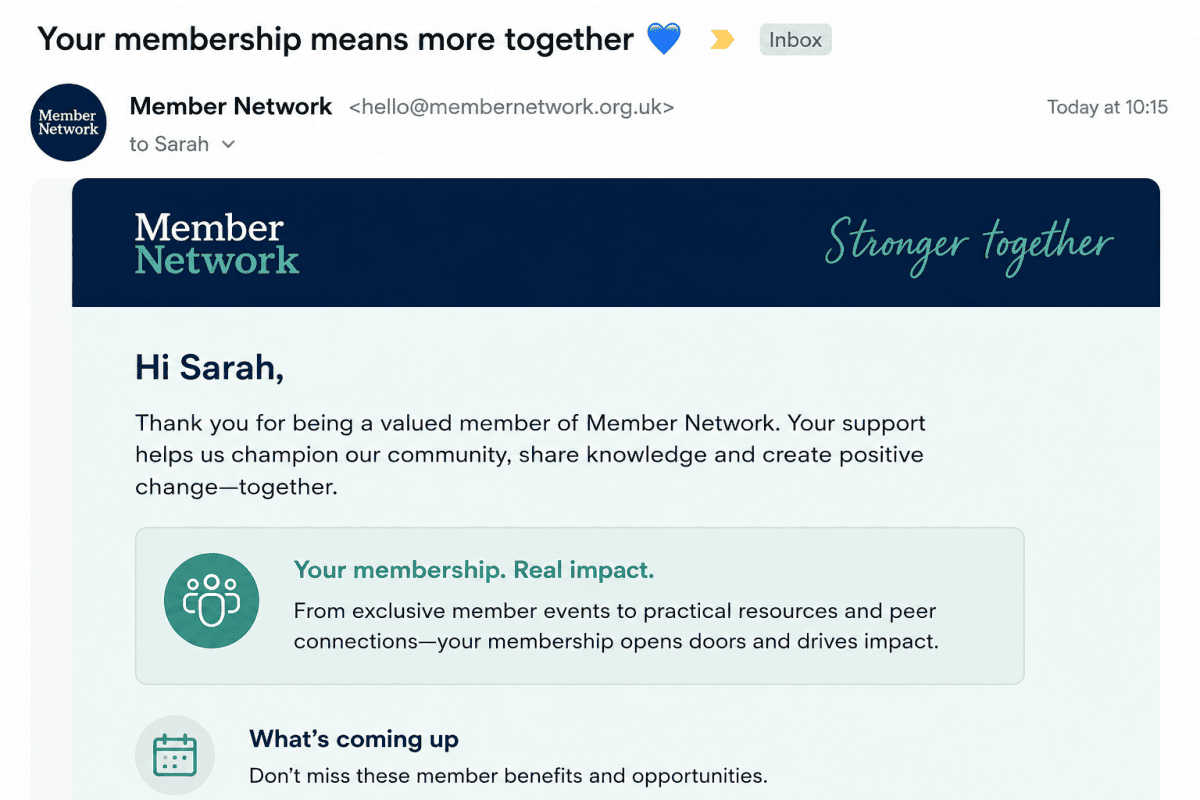
This can support more targeted communications and campaigns, helping organisations deliver information that is more relevant to different groups of members.
For example, highly engaged members could receive information about new opportunities, while members showing declining engagement could receive targeted communications designed to demonstrate the ongoing value of their membership.
Better personalisation can contribute to stronger engagement and reinforce the value of remaining a member.
6. Reporting Is Time-Consuming or Unreliable
Membership organisations rely on accurate information to make effective decisions.
Leadership teams may need visibility of membership growth, retention, engagement, renewals and other performance indicators. But when information is held across multiple systems, producing these reports can require significant manual effort.
Data may need to be exported from several platforms, combined in spreadsheets and cleaned before meaningful analysis can begin.
By the time the report is ready, the information may already be out of date.
A connected membership management platform can make reporting more accessible by bringing relevant data together.
Dashboards and reporting tools can provide teams with clearer visibility of membership trends and organisational performance. Rather than relying solely on retrospective reports, decision-makers can access more current information and identify emerging opportunities or challenges sooner.
7. Your Existing Processes Cannot Support Further Growth
Processes that work for hundreds of members may not work effectively for thousands.
As membership grows, manual administration increases, data becomes harder to manage and maintaining a consistent member experience becomes more challenging.
Common warning signs include needing additional staff simply to manage administration, reaching the practical limits of existing spreadsheets or finding that systems cannot easily accommodate new membership types, services or processes.
Technology can then become a constraint on growth rather than an enabler of it. Scalable membership management software can provide a stronger foundation for expansion.
By automating processes and centralising information, organisations can increase membership without necessarily increasing administrative workloads at the same rate.
The result is a more scalable operating model that can support growth while maintaining service quality and member engagement.
If several of these signs are familiar, the question may no longer be whether your organisation needs membership management software, but what type of platform can support your requirements now and in the future.
Why Use Microsoft Dynamics 365 For Membership Management?
There are many dedicated membership management platforms available. For organisations with relatively straightforward requirements, an off-the-shelf solution may provide the functionality they need.
However, larger or more complex membership organisations may require greater flexibility. Microsoft Dynamics 365 can provide a configurable foundation for membership management, allowing organisations to create processes around their specific membership models rather than adapting operations to the limitations of a rigid platform.
Member profiles can bring together contact information, membership details, communication history, interactions and other relevant data. This provides teams with a more complete view of the relationship between each member and the organisation.
Dynamics 365 can also support processes across the wider membership lifecycle. Workflows can be configured around applications, onboarding, engagement and renewals, helping reduce repetitive administration and create more consistent member experiences.
For organisations with multiple membership types, complex organisational structures or evolving service offerings, this flexibility can be particularly valuable.
Creating a Connected Membership Management Platform
One of the advantages of using Dynamics 365 for membership management is its connection with the wider Microsoft technology ecosystem. Power Automate can automate processes and workflows, reducing manual administration and ensuring actions take place at the appropriate stage of the member journey.
Power BI can turn membership data into dashboards and reports, giving teams clearer insight into areas such as engagement, retention, membership growth and renewal performance. Dynamics 365 can also integrate with other business applications, helping organisations reduce data silos and create more connected digital processes.
Rather than implementing another isolated membership database, organisations can build a platform that connects membership management with their wider technology environment.
Ultimately, the right membership management software should do more than store member details. It should help your organisation understand its members, strengthen engagement, improve operational efficiency and provide the flexibility needed to evolve.
For membership organisations with more complex requirements, Dynamics 365 offers a scalable and configurable approach to membership management that can adapt as the organisation, its services and its members' expectations change. For more, get in touch with our Dynamics 365 experts.