
Modern supply chain strategy for manufacturers must extend beyond operational efficiency.
In an environment shaped by volatility, margin pressure and increasing customer expectations, the supply chain has become a strategic lever for profitability, resilience and growth.
To meet these demands, manufacturers are moving away from disconnected planning tools and siloed decision‑making toward an ERP‑led model.
By integrating finance, procurement and production within a single system of record, ERP enables organisations to align execution with financial outcomes, manage risk more effectively and make faster, better‑informed decisions.
Why ERP Should Anchor Supply Chain Strategy
Many manufacturing organisations still rely on fragmented systems. Demand planning may live in spreadsheets, procurement in isolated purchasing tools and finance in parallel reporting structures. While each function may operate effectively on its own, the lack of integration creates friction, delays and conflicting priorities.
An ERP‑led supply chain strategy addresses this by establishing a shared operational and financial model. Core supply chain data - such as forecasts, bills of material, routings, supplier lead times and cost structures - resides in one environment, reducing manual reconciliation and improving decision speed.
ERP also ensures that operational plans are financially grounded. Production schedules, inventory targets and sourcing strategies can be evaluated not just on service or utilisation, but on their impact on margin, cash flow and working capital. This alignment is essential for manufacturers seeking scalable, repeatable performance rather than short‑term optimisation.
Core Principles of an ERP‑Led Model
A successful ERP‑led Supply Chain Strategy is built on a small number of clear principles rather than complex frameworks.
One plan, one version of the truth: Demand, supply and financial plans must be aligned and synchronised within ERP so teams are working from consistent assumptions.
Finance embedded in decision‑making: Cost, margin and cash implications should be visible at the point decisions are made, not analysed retrospectively.
Closed‑loop execution: Plans must flow directly into procurement and production, with actual performance feeding back into continuous improvement.
Together, these principles ensure that ERP supports the way the organisation actually operates, rather than becoming a reporting layer disconnected from reality.
Integrating Finance: Making Supply Chains Financially Intelligent
Finance plays a defining role in an ERP‑led supply chain strategy. Instead of acting solely as a control function, finance becomes an active participant in shaping operational choices.
ERP enables standard costing to be linked directly to planning and execution. Variances in material cost, labour or overhead can be traced back to sourcing decisions, engineering changes or production performance, creating transparency and accountability across functions.
Beyond cost control, ERP supports deeper insight into profitability. By capturing landed costs and cost‑to‑serve data, manufacturers can understand the true margin of products, customers and channels. This enables more informed decisions around pricing, service levels and portfolio rationalisation.
Working capital management is also strengthened. Inventory policies, lead times, and payment terms can be assessed for their impact on cash flow, enabling finance and operations leaders to balance service levels with liquidity objectives. Scenario modelling further supports resilience planning by showing how changes in demand or supply conditions affect financial outcomes.
Integrating Procurement: Aligning Supply with Strategy
In an ERP‑led environment, procurement evolves from a transactional buying function into a strategic enabler of supply chain performance.
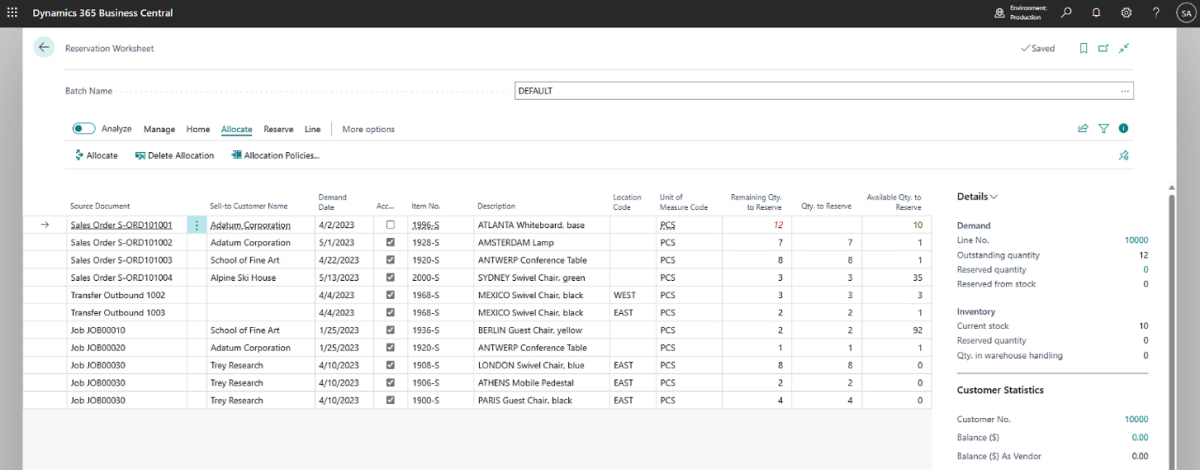
ERP centralises supplier data, ensuring consistency across planning, purchasing and quality processes. Lead times, minimum order quantities and contractual terms are embedded directly into planning logic, improving the accuracy of material requirements planning and reducing last‑minute expediting.
Key benefits of procurement integration include:
- Improved supplier reliability through shared forecasts and performance tracking
- Better total‑cost decisions by linking price, quality and delivery performance
- Enhanced risk visibility across sourcing regions and supplier tiers
By connecting procurement decisions to both operational plans and financial outcomes, ERP supports a more balanced approach to cost, continuity and service.
Integrating Production: Turning Plans into Predictable Performance
Production is where a supply chain strategy ultimately succeeds or fails.
ERP‑led integration ensures that production plans are both achievable and aligned with broader business objectives.
Accurate routings, capacity models and calendars allow planners to understand true constraints and avoid unrealistic commitments. Where supported, finite scheduling tools integrated with ERP help sequence work efficiently, reducing changeovers and improving adherence to plan.
Capturing shop‑floor execution data is equally important. Actual labour, scrap, downtime and yield data provide critical feedback that improves future planning accuracy and highlights opportunities for continuous improvement. When production performance is visible in both operational and financial terms, improvement efforts can be prioritised based on impact rather than intuition.
Engineering change control further benefits from ERP integration. Effectivity dates, revision management and inventory disposition rules help manufacturers introduce changes without disrupting schedules or incurring unnecessary write‑offs.
Data Foundations That Enable Alignment
Even the most advanced ERP cannot deliver value without reliable data. Strong data foundations are therefore essential to any ERP‑led supply chain strategy.
This begins with disciplined master data management. Item masters must include accurate planning parameters, lifecycle statuses and ownership, while bills of material and routings require regular validation against shop‑floor reality. Supplier lead times and calendars should be reviewed periodically to ensure they reflect actual performance rather than historical assumptions.
Clear data ownership, supported by approval workflows and automated checks, helps maintain integrity over time. This governance ensures that planning outputs remain trusted as the business scales or changes.
Governance And Operating Rhythm
Technology enables integration, but governance sustains it. An ERP‑led supply chain strategy requires a structured operating rhythm that brings functions together around shared decisions.
A formal S&OP or integrated business planning process provides the forum where demand, supply and financial perspectives are reconciled. Importantly, this process should conclude with a committed plan within ERP, rather than a disconnected presentation.
At an operational level, regular reviews supported by ERP dashboards and alerts ensure that deviations from plan are identified and addressed early. Clear ownership of decisions, overrides and master data changes reinforces accountability and reduces noise across the organisation.
Measuring Success
An effective supply chain strategy balances service, efficiency and financial performance. Rather than managing isolated metrics, ERP allows manufacturers to view performance holistically.
Key measures typically span:
- Customer service and demand accuracy
- Production reliability and supplier performance
- Inventory efficiency, cost‑to‑serve and margin
When these metrics are connected in ERP, leaders can understand trade‑offs clearly and prioritise actions that deliver the greatest overall benefit.
The Strategic Payoff
An ERP‑led supply chain strategy transforms how manufacturers operate. By integrating finance, procurement and production, organisations move from reactive firefighting to proactive, financially informed decision‑making.
The benefits are tangible: improved service levels, lower total cost, reduced working capital and greater resilience to disruption.
More importantly, the supply chain becomes a strategic asset—one that supports sustainable growth, profitability and confidence in an increasingly complex manufacturing landscape.