Many facilities management providers are turning to technology to tackle their industry’s challenges. But this approach is not necessarily paying off.
In response to cost and service pressures, providers are layering systems on top of systems: a CAFM platform here, a finance system there, workforce tools, spreadsheets, and manual reporting processes filling the gaps.
The result is not a lack of data, but a lack of control. Leadership teams struggle to get a single, reliable view of compliance, operational performance, and contract profitability.
Microsoft Dynamics 365 is addressing this challenge for the industry. By providing a unified operational and commercial backbone for facilities management providers - rather than adding yet another point solution - it brings people, assets, contracts, finance, and customer relationships into one intelligent platform.
This article explores how Dynamics 365 transforms facilities management operations in practice, what changes day to day for operations and leadership teams, and how organisations achieve measurable ROI without increasing complexity.
From Fragmented Systems to Operational Control
In most facilities management organisations, core operational processes are spread across disconnected systems. Work orders may live in a CAFM tool, labour costs in finance, compliance evidence in technician apps or site folders, and contract data in spreadsheets or CRM systems. Each system may work adequately in isolation, but together they create blind spots.
Dynamics 365 changes this by acting as a unifying layer across operations and finance. Work orders, assets, labour, parts, subcontractors, and costs are connected to contracts and customers in real time. This creates a single source of truth that is shared by schedulers, technicians, finance teams, compliance leads, and executives. Instead of reconciling information after the fact, teams operate from consistent, current data.
The impact of this shift is immediate. Questions that previously took days of manual effort to answer can now be addressed in minutes. Leaders gain confidence in the numbers they see, and operational teams gain clarity about priorities and expectations.
Compliance as a Continuous State, Not an Annual Event
Compliance is one of the defining pressures in facilities management, particularly across regulated services such as water hygiene, HVAC, lifts, gas, and electrical systems.
Traditionally, compliance evidence is gathered reactively. Preparing for audits or client reviews often becomes a high-stress exercise in chasing documents, photos, certificates, and sign-offs across multiple systems and suppliers.
With Dynamics 365, compliance is embedded directly into the flow of work. Planned maintenance schedules, risk assessments, service reports, and digital forms are linked to specific assets, sites, and contracts. Technician qualifications and certifications are connected to scheduling, ensuring that only appropriately certified staff are assigned to regulated tasks.
As work is completed, evidence is captured once, at source, via mobile devices. Photos, checklists, timestamps, and customer sign-off are automatically associated with the relevant asset and contract. This allows compliance reporting to be generated on demand, rather than assembled manually under pressure.
The practical outcome is a state of ongoing audit readiness. Exceptions are flagged early, non-conformances are visible as they arise, and leadership teams can demonstrate control with confidence. For clients, this translates into greater trust and fewer escalations. For providers, it reduces risk and significantly cuts the effort required for audits and reporting.
Improving Workforce Productivity Without Increasing Headcount
Workforce availability and productivity are persistent challenges for facilities management providers. Labour shortages, high attrition, and complex multi-site scheduling make it difficult to deploy the right people at the right time. Inefficient scheduling and manual administration further erode productivity and margin.
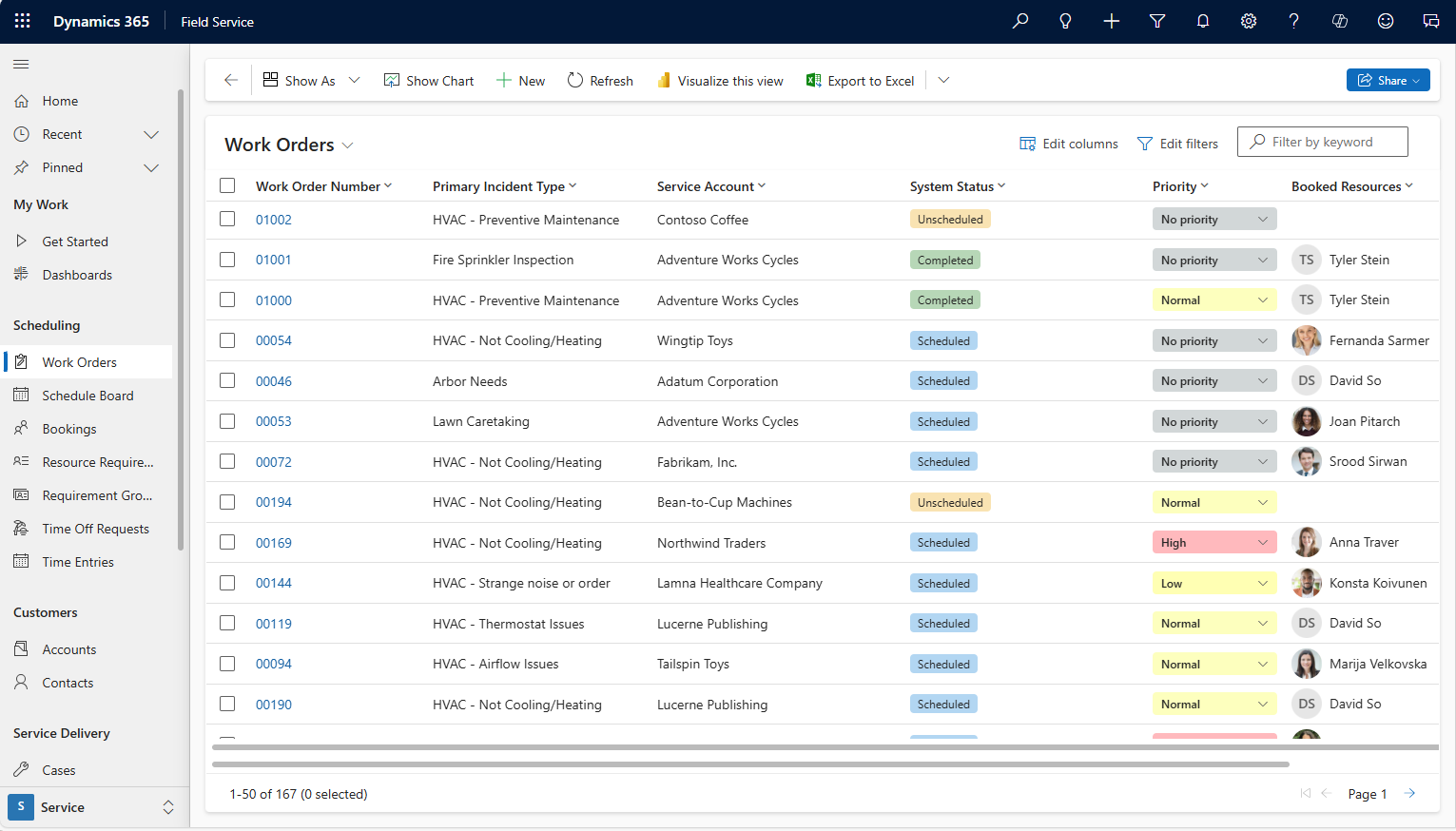
Dynamics 365 supports a more intelligent approach to workforce management. Scheduling is skills- and certification-aware, taking into account availability, location, SLAs, and job requirements. This reduces misallocation, improves first-time fix rates, and limits unnecessary overtime or rework.
Technicians use mobile tools to receive jobs, capture time, record parts usage, and complete compliance forms in a single workflow. This eliminates duplicate data entry and delays in timesheet submission. Subcontractors can be managed within the same operational framework, with agreed rates, SLAs, and compliance requirements clearly defined.
Over time, leadership teams gain visibility into utilisation, overtime drivers, and productivity trends across regions and service lines. This enables more informed decisions about resourcing, training, and subcontractor usage, improving service quality while protecting margins.
Asset Visibility And Smarter Lifecycle Decisions
Many facilities management operations have incomplete or inconsistent asset data. Service histories are fragmented, and lifecycle decisions are often driven by immediate failures rather than long-term insight. This reactive approach increases costs, downtime, and client dissatisfaction.
By consolidating asset data within Dynamics 365, providers build a comprehensive view of each asset’s history, performance, and cost to maintain. Maintenance activity, failures, parts usage, and downtime are all linked to the asset record and the associated contract.
This level of visibility enables a shift from reactive maintenance to more proactive, risk-based strategies. Patterns become visible, allowing teams to identify assets that are driving disproportionate cost or risk. Lifecycle decisions, such as repair versus replacement, can be supported with evidence rather than intuition.
For clients, this supports more credible conversations about investment, risk reduction, and long-term value. For providers, it reduces unplanned work and improves predictability across service delivery.
Commercial Control and Margin Protection
Cost control under fixed-price and inflation-pressured contracts is one of the most critical challenges facing facilities management leaders. In many organisations, financial insight lags behind operational reality. By the time margin erosion is visible in finance reports, it is often too late to intervene.
Dynamics 365 brings operational and financial data together in near real time. Labour, materials, subcontractor costs, and variations flow directly from service delivery into contract and project accounting. Purchase orders and approvals are embedded into operational workflows, reducing leakage and improving billing accuracy.
This allows leadership teams to monitor contract profitability continuously rather than retrospectively. Early warning signs of margin pressure can be identified and addressed through operational changes, client discussions, or commercial renegotiation. Forecasting and resource planning also improve, as delivery data feeds directly into financial projections.
The result is tighter control, faster intervention, and more defensible commercial decision-making.
Client Reporting That Builds Confidence
Client reporting is a visible measure of professionalism and control. Yet in many facilities management organisations, monthly or quarterly reports remain manual, time-consuming, and inconsistent. This not only drains internal resources but also undermines client confidence.
With Dynamics 365, reporting is driven directly from live operational data. Dashboards and automated report packs provide clients with clear visibility into compliance status, SLA performance, asset health, and service volumes. Because the data is consistent and traceable, reports stand up to scrutiny.
Account teams are freed from manual collation and can focus instead on interpretation and improvement planning. Client conversations move away from explanations and towards outcomes, strengthening relationships and supporting renewals and expansion.
A Practical, Low-Risk Implementation Approach
A common concern with enterprise platforms is complexity and disruption. Successful facilities management operations address this by adopting Dynamics 365 in phases, aligned to clear business outcomes.
Initial phases typically focus on scheduling, mobile execution, compliance evidence capture, and executive visibility. These areas deliver rapid value and build confidence across the organisation. Subsequent phases extend into subcontractor management, inventory, forecasting, and advanced commercial analytics.
Crucially, Dynamics 365 can coexist with existing CAFM systems during transition. This allows organisations to protect prior investments while progressively consolidating control where it delivers the greatest benefit.
Defensible ROI for Facilities Management Operations
Facilities management providers adopting Dynamics 365 consistently realise value across several measurable dimensions.
Reporting and audit preparation effort is significantly reduced through automation. Workforce productivity improves through better scheduling and reduced administrative burden. Margin leakage is identified and addressed earlier through real-time cost visibility. Asset decisions become more informed, reducing reactive spend and downtime.
Perhaps most importantly, organisations are able to scale operations and client portfolios without a proportional increase in back-office headcount.
These outcomes combine to deliver a strong, defensible return on investment that resonates with operational leaders, finance teams, and executive stakeholders alike.
Conclusion
Facilities management organisations do not need more disconnected tools. They need control, confidence, and clarity across increasingly complex operations. Microsoft Dynamics 365 provides a unified platform that connects people, assets, contracts, and finance, enabling consistent service delivery, defensible compliance, and stronger commercial performance.
By embedding compliance into daily operations, improving workforce productivity, enhancing asset insight, and protecting margins, Dynamics 365 supports sustainable growth without adding operational complexity.
For facilities management leaders under pressure to deliver more with less, it provides the operational backbone required to move from reactive management to proactive control.
Ready to explore Dynamics 365 for your facilities management operations? Reach out today: