For every successful organisation, accurate financial management starts with a reliable General Ledger. While finance teams often focus on reporting, forecasting and business performance, all of these activities depend on the quality and accuracy of the financial data that sits beneath them.
In Microsoft Dynamics 365 Business Central, the General Ledger acts as the central repository for financial information, providing businesses with a complete and accurate record of every financial transaction. From day-to-day postings through to financial reporting and business intelligence, the General Ledger forms the foundation of effective financial management.
As organisations grow, managing finances becomes more complex. Multiple departments, locations, projects and reporting requirements can make it difficult to maintain visibility and control. Business Central addresses these challenges by combining a powerful General Ledger with modern reporting, automation and analysis capabilities that help finance teams work more efficiently and make better-informed decisions.
What Is the General Ledger in Business Central?
The General Ledger (GL) is the core financial record within Business Central. Every financial transaction generated throughout the system ultimately posts to the General Ledger, creating a comprehensive view of an organisation's financial position.
Whether a transaction originates from sales, purchasing, inventory, fixed assets, cash management or journals, the resulting financial impact is recorded within the General Ledger.
Think of the General Ledger as the financial backbone of the business. It provides the information required to produce key financial statements, monitor performance and maintain compliance with accounting standards and regulatory requirements.
Without an accurate General Ledger, organisations cannot confidently measure profitability, understand cash flow or produce reliable management reports.
Why the General Ledger Matters
The General Ledger does far more than record transactions. It provides the financial foundation that enables organisations to:
- Produce accurate financial statements.
- Monitor business performance.
- Meet compliance obligations.
- Support external audits.
- Improve cash flow visibility.
- Enable strategic decision-making.
Every financial report generated from Business Central draws its information from the General Ledger. If transactions are not recorded correctly, reporting accuracy suffers and business decisions may be based on incomplete or inaccurate information.
For growing organisations, maintaining a clean and structured General Ledger becomes increasingly important as transaction volumes, reporting requirements and organisational complexity increase.
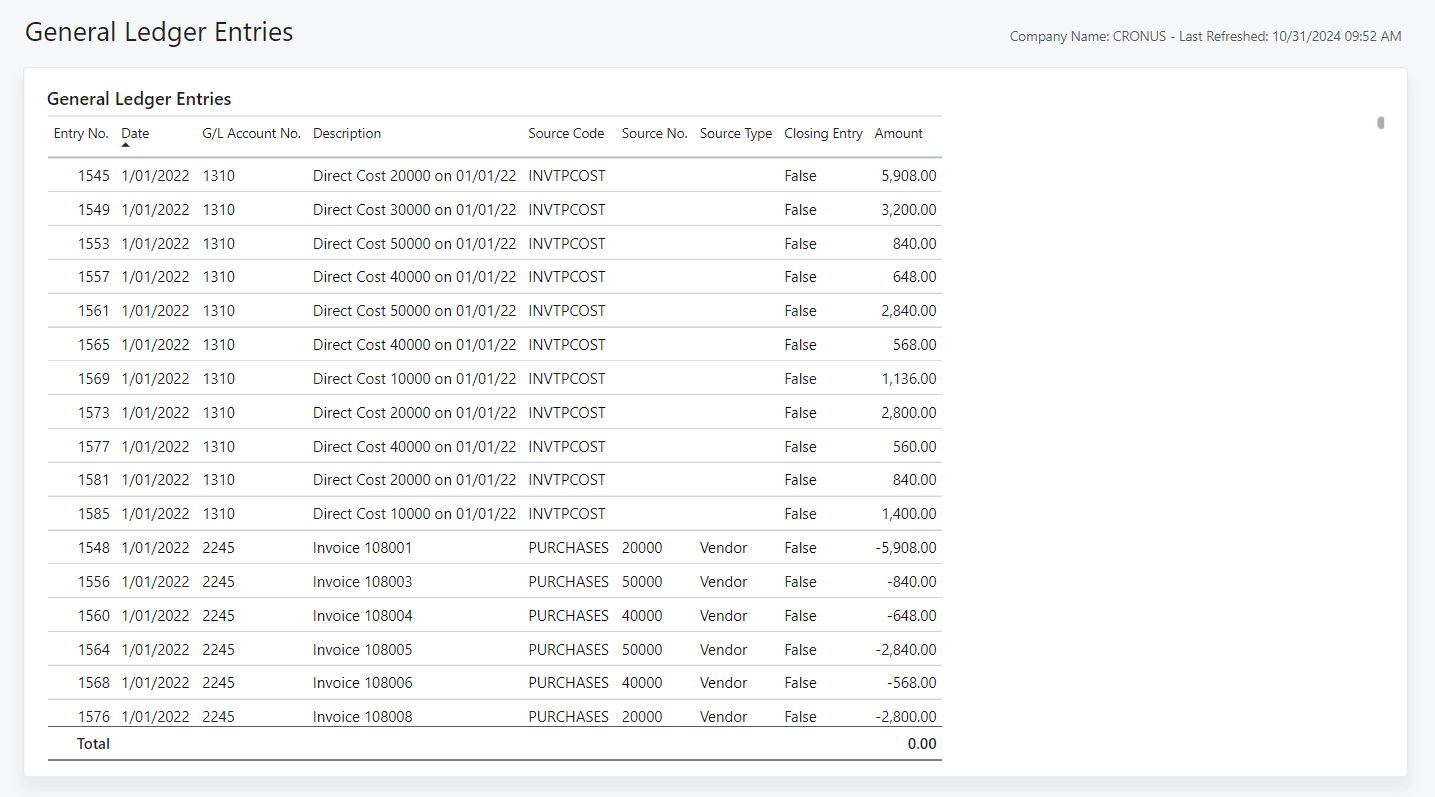
How the General Ledger Works in Business Central
Business Central is designed to automate and simplify financial management. When users process transactions throughout the system, the relevant financial entries are automatically posted to the General Ledger.
Examples include:
- Sales invoices generating revenue postings.
- Purchase invoices recording expenditure.
- Customer payments updating receivables.
- Supplier payments reducing liabilities.
- Journal entries recording adjustments and accruals.
- Bank transactions updating cash balances.
Because Business Central integrates financial data across the organisation, there is no need to manually consolidate information from separate systems. Transactions flow seamlessly into the General Ledger, ensuring financial records remain current and accurate.
This real-time approach provides finance teams with immediate visibility into business performance rather than waiting until month-end to understand financial results.
Understanding The Chart Of Accounts
At the heart of the General Ledger is the Chart of Accounts.
The Chart of Accounts provides the structure that organises financial data within Business Central. Each account represents a category used to record and track specific types of financial activity, such as revenue, expenses, assets, liabilities and equity.
A well-designed Chart of Accounts helps organisations:
- Improve reporting accuracy.
- Simplify financial analysis.
- Support management reporting.
- Reduce administrative complexity.
- Enable more consistent financial governance.
One of Business Central's strengths is its flexibility. Organisations can structure accounts to suit their reporting needs while maintaining a scalable financial framework that can adapt as the business grows.
Using Dimensions For More Meaningful Financial Reporting
Many organisations face a common challenge when building financial reports. As they require greater insight into departments, locations, projects or cost centres, the Chart of Accounts can become unnecessarily large and difficult to manage. Business Central addresses this challenge through Dimensions.
Dimensions allow organisations to add additional reporting categories to transactions without creating hundreds of separate General Ledger accounts. This enables finance teams to analyse performance from multiple perspectives while keeping the General Ledger structure clean and manageable.
For example, businesses may wish to track financial performance by:
- Department.
- Location.
- Business unit.
- Customer type.
- Project.
- Cost centre.
Rather than expanding the Chart of Accounts, Dimensions provide a more flexible and scalable way to analyse financial information.
This capability is particularly valuable for organisations that require detailed reporting across multiple areas of the business.
Real-Time Financial Visibility
One of the key advantages of Business Central's General Ledger is the ability to access financial information in real time.
Traditional finance processes often rely on spreadsheets, manual exports and month-end reporting cycles. While these approaches may provide useful snapshots of performance, they do not always offer the most current view of the business.
With Business Central, financial transactions update the General Ledger as they are processed. This enables finance leaders to monitor performance throughout the month, identify issues earlier and make decisions based on current information rather than historical reports.
Real-time visibility supports:
- More accurate forecasting.
- Better cash flow management.
- Faster financial reporting.
- Improved operational decision-making.
- Greater confidence in financial data.
For organisations operating in fast-moving industries, access to current financial information can provide a significant competitive advantage.
What Financial Reports Can Be Generated From The General Ledger?
The General Ledger provides the data required to generate many of the reports relied upon by finance teams and business leaders.
These include:
- Profit and Loss reports.
- Balance Sheets.
- Trial Balances.
- Cash Flow reports.
- Budget comparisons.
- Departmental profitability analysis.
- Management accounts.
Because all reporting draws from a central source of financial data, organisations can produce consistent and reliable reporting across the business.
Finance leaders gain greater confidence in the accuracy of the information being used to assess performance and support strategic planning.
Unlocking Deeper Insights With Power BI
While traditional financial reports remain essential, many organisations now want greater visibility into trends, performance drivers and opportunities for improvement.
Business Central integrates with Microsoft Power BI, enabling organisations to transform General Ledger data into interactive dashboards and analytical reports.
By combining Power BI with General Ledger information, businesses can:
- Visualise financial performance.
- Monitor revenue and expenditure trends.
- Analyse profitability.
- Track key financial metrics.
- Identify anomalies and variances more quickly.
- Provide executives with real-time financial dashboards.
Rather than spending time manually building reports, organisations can gain deeper insights from their financial data and make more informed decisions.
This helps shift finance teams from simply reporting on past performance to actively supporting future business growth.
Improving Financial Control, Governance And Compliance
Strong financial control is essential for every organisation, regardless of size.
Business Central's General Ledger helps maintain financial discipline by providing structured posting processes, detailed transaction histories and comprehensive audit trails.
This supports a range of business objectives, including:
- Financial governance.
- Internal control processes.
- Audit preparation.
- Regulatory compliance.
- Risk management.
Because financial activity can be traced back to its source, organisations gain greater transparency and accountability across financial operations.
This becomes particularly important as businesses grow, operate across multiple entities or face increasing compliance requirements.
Supporting Growth With Scalable Financial Management
As organisations expand, financial complexity inevitably increases. More transactions, additional reporting requirements and multiple operating entities can place strain on traditional accounting systems.
Business Central is designed to scale alongside growing organisations.
Its General Ledger capabilities support businesses that require:
- Multi-company management.
- Multi-currency accounting.
- Departmental reporting.
- Advanced financial analysis.
- Higher transaction volumes.
- More sophisticated governance controls.
This scalability enables organisations to maintain effective financial management without introducing unnecessary complexity or administration.
How Copilot Supports Modern Finance Teams
Microsoft is continuing to enhance Business Central through the introduction of AI-powered capabilities, including Copilot.
While the General Ledger remains the foundation of financial management, Copilot has the potential to help finance professionals access information more quickly, analyse data more efficiently and improve productivity across routine financial tasks.
Combined with Business Central's existing automation and reporting capabilities, AI is helping organisations move towards more intelligent and proactive financial management.
As these technologies continue to evolve, finance teams will be able to spend less time gathering information and more time delivering strategic value to the organisation.
How Akita Intelligent Solutions Can Help
At Akita Intelligent Solutions, we help organisations implement, optimise and support Microsoft Dynamics 365 Business Central to improve financial visibility, operational efficiency and business performance.
Whether you are replacing legacy accounting systems, improving reporting capabilities or looking to gain more value from your existing Business Central deployment, our specialists can help you build a finance platform that supports long-term growth.
By combining the power of Business Central, Power BI and Microsoft's wider business applications ecosystem, organisations can transform their General Ledger from a record-keeping function into a strategic foundation for smarter financial management.
Want to know more? Speak to our Business Central consultants today.