For many organisations involved in field service, maintenance, facilities management, or after-sales support, the pressure to deliver faster response times, higher service quality, and improved profitability exposes a fundamental issue: service operations are frequently held together by fragmented systems and manual processes.
When service delivery relies on disconnected tools such as spreadsheets, inboxes, standalone scheduling applications, and separate finance systems, inefficiencies compound quickly. Time is lost re-entering data, coordinating work manually, resolving billing discrepancies, and clarifying ownership of service tasks. Margins erode quietly through unbilled labour, misapplied contract terms, unnecessary repeat visits, and delayed invoicing.
Service Management in Microsoft Dynamics 365 Business Central is designed to address these challenges by bringing service execution, asset information, inventory, contracts, and financial outcomes together within a single ERP platform. Used effectively, it enables organisations to run service as a structured, measurable business function rather than a reactive operational burden.
This guide explains how Service Management in Business Central works, which capabilities matter most to business leaders, and—most importantly—how to apply them practically to improve efficiency across the entire service lifecycle.
What is Service Management in Business Central?
Service Management in Business Central is a native set of capabilities within Microsoft Dynamics 365 designed to manage service-related activity end to end. It supports the operational flow of service delivery while maintaining full financial and commercial traceability.
From the initial service request through to completion and invoicing, all activity is managed within a single system. Service orders become the central record linking customer information, service items or assets, assigned resources, parts consumption, labour time, contract entitlements, warranties, and billing outcomes.
This creates a complete audit trail and a shared source of truth across service, operations, and finance teams.
This level of integration is critical for efficiency. Instead of synchronising data across multiple platforms—or relying on individuals to bridge gaps manually—Business Central ensures that decisions are based on consistent, up-to-date information.
Why Efficiency Is The Defining Challenge In Service Operations
Service operations are complex by nature. They involve people, schedules, assets, inventory, locations, customer expectations, and often strict service level agreements, all interacting in real time.
Without structure and visibility, service becomes reactive and unpredictable, which typically drives up cost.
Common symptoms of inefficient service operations include:
- Recurring SLA breaches,
- Growing backlogs of unresolved wor
- Underutilised or overworked technicians
- High levels of rework
- Frequent billing disputes
These issues are rarely caused by a lack of effort. Instead, they result from poor coordination, inconsistent processes, and limited visibility into what is actually happening across the service function.
Modern service management focuses on standardising workflows, improving planning accuracy, and aligning operational decisions with financial impact. Service Management in Business Central supports this approach by embedding automation, operational structure, and real-time data into everyday service processes.
Service Management In Business Central: What Business Leaders Should Expect
At a leadership level, the value of Service Management with Business Central lies less in features and more in outcomes.
When implemented properly, it supports faster response and resolution times, higher technician productivity, improved first-time fix rates, and stronger control over service margins. It also improves customer retention by enabling more reliable, consistent service experiences.
Crucially, the module provides a single operational and financial view of service activity. Leaders gain visibility into what work is coming in, how it is being delivered, what it costs to fulfil, and which customers, contracts, and service types are truly profitable.
The Capabilities That Deliver Real Efficiency Gains
Service order management is the operational foundation
Service orders sit at the heart of Service Management in Business Central and act as the primary control mechanism for service delivery. Each order captures the full context of a service requirement, including the customer, the service item or asset involved, the work to be performed, the resources required, and the expected timeline.
By managing service requests consistently through structured orders, organisations reduce reliance on informal coordination via email or phone calls. Progress can be monitored in real time, costs are captured as work is completed, and responsibility for each stage of the process is clearly defined. This alone can significantly reduce delays, rework, and administrative overhead.
Asset and service item tracking to improve first-time fix rates
Efficiency in service delivery depends heavily on understanding what is being serviced. When technicians arrive without accurate asset history or configuration information, diagnosis takes longer and repeat visits become more likely.
Business Central allows organisations to maintain detailed records for service items and assets, including their service history, installed components, warranty coverage, and known issues. This contextual information ensures technicians are better prepared before arriving on site, with clearer expectations and the correct parts.
Over time, this visibility improves diagnostic accuracy, reduces repeat call-outs, and increases the proportion of issues resolved on the first visit.
Contract and warranty management to protect margin
Service contracts and warranties can be a major source of recurring revenue, but they also introduce complexity. Without clear visibility into entitlements and coverage, organisations risk over-servicing customers, misapplying rates, or missing renewal opportunities.
Service Management in Business Central supports the structured management of service contracts, including defined terms, coverage rules, price agreements, and renewal schedules. During service execution, warranty and contract validation can be applied automatically, ensuring that billing aligns with contractual obligations.
From an efficiency perspective, this reduces administrative effort, prevents revenue leakage, and provides greater predictability in both workload planning and income.
Resource scheduling and dispatch as a margin lever
How technicians are scheduled and dispatched has a direct impact on service profitability. Poor allocation decisions lead to unnecessary travel, idle time, and missed commitments.
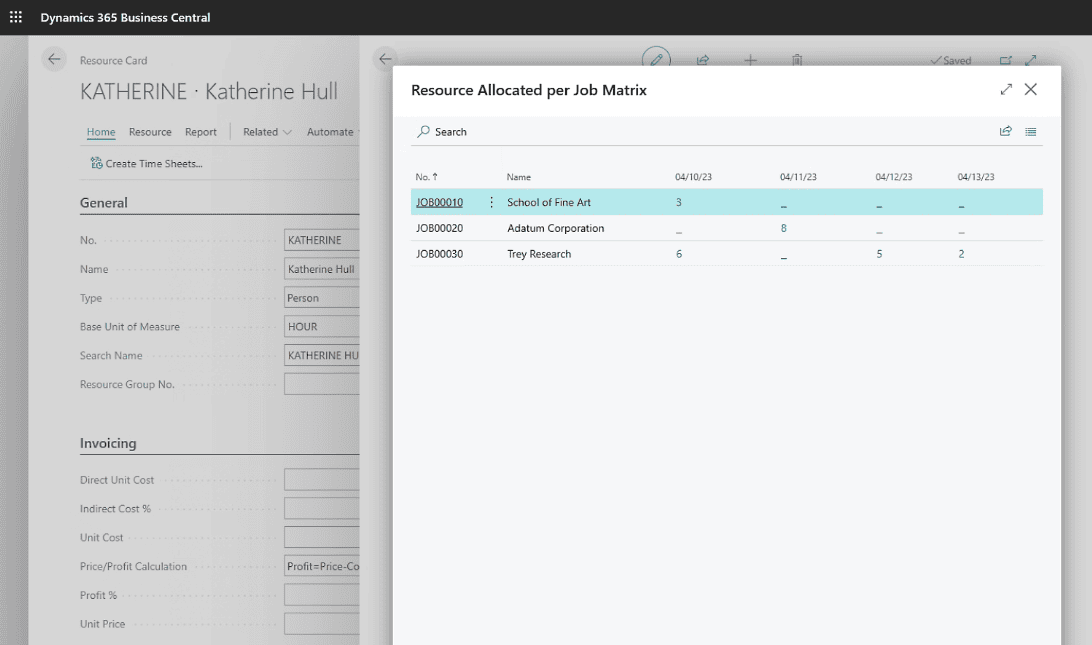
Business Central provides tools to allocate resources based on availability, workload, and skill set. Schedulers can see capacity constraints, rebalance workloads, and make adjustments as service demands change. While not a full route-optimisation engine, this structured approach is a significant improvement over manual scheduling methods.
The result is better utilisation of skilled resources, reduced travel inefficiencies, and more consistent service delivery.
Inventory integration to minimise service disruption
Service delivery and inventory management are tightly linked. Delays often occur because parts are unavailable, incorrectly reserved, or consumed without being recorded.
By integrating service orders directly with inventory, Business Central ensures that
- Parts can be allocated in advance
- Usage is captured accurately
- Replenishment decisions reflect actual service demand.
This alignment reduces downtime, supports better first-time fix rates, and improves inventory accuracy across the organisation.
Pricing and invoicing automation to eliminate revenue leakage
Manual pricing processes often lead to inconsistency and billing delays. Over time, this results in lost revenue and strained customer relationships.
Service Management in Business Central supports automated pricing rules that can reflect contract terms, labour types, or service categories. Invoices can be generated directly from completed service orders, ensuring that all billable work is captured promptly and accurately.
This automation shortens billing cycles, improves cash flow, and reduces disputes, all of which contribute directly to operational efficiency and margin protection.
Reporting and performance visibility for continuous improvement
Efficiency gains are only sustainable if they can be measured. Business Central provides reporting across technician productivity, response and resolution times, contract profitability, and service cost drivers.
For leadership teams, this visibility enables informed decision-making. Bottlenecks can be identified, underperforming processes addressed, and best practices standardised across the service organisation.
A Practical Framework For Improving Efficiency
Understanding functionality is only the first step. Real efficiency gains come from how the system is configured, adopted, and governed.
Standardisation
Defining consistent service types, fault codes, priority levels, and status workflows removes ambiguity and enables automation. This, in turn, reduces decision friction and accelerates service execution.
Centralising Service Requests
When all requests enter the system through a single channel, teams gain a clear view of demand, enabling better prioritisation and faster response times. Informal side channels undermine visibility and should be eliminated wherever possible.
Resource Allocation
This should then be optimised based on skill, availability, and geography. This ensures that technicians are deployed efficiently and that work is completed with minimal disruption.
Organisations should also use service contracts to move away from reactive service models. Planned maintenance and recurring service activities create more predictable workloads, smoother scheduling, and more stable revenue streams.
Integrating inventory tightly with service operations is another critical step. Pre-allocating parts, tracking consumption accurately, and linking service demand to replenishment improves both service reliability and inventory control.
Finally, pricing and billing processes should be automated and governed centrally. When billing is a direct outcome of service completion, revenue is protected and cash flow improves.
Typical Efficiency Outcomes In Practice: What’s the ROI?
Organisations that implement Service Management in Business Central effectively often see measurable improvements within months.
Service delays reduce as work is structured and visible. Technician productivity increases as scheduling improves and rework declines. Customer satisfaction rises as service becomes more predictable and transparent.
Perhaps most importantly, leadership teams gain clarity over where service makes money and where it does not—allowing for informed strategic decisions about pricing, contracts, and service design.
Overcoming common Business Central implementation challenges
The most common obstacle to success is poor data quality. Incomplete asset records, inconsistent service definitions, or unclear contract terms will undermine the system’s effectiveness. Establishing clear data governance standards early is essential.
Resistance to process change is another frequent challenge. Service teams may initially view structured workflows as restrictive. This can be addressed through targeted training, simplified user experiences, and clear demonstrations of how the system reduces unnecessary effort.
Finally, many organisations underutilise the module’s capabilities. A phased adoption plan, supported by regular operational reviews, helps ensure that value is realised beyond basic service order processing.
Strategic benefits beyond operational efficiency
While efficiency is often the primary driver, Service Management in Business Central delivers broader strategic value. It enables service operations to function as a scalable, revenue-generating capability rather than a reactive cost centre. It strengthens alignment between service, finance, and operations, and supports long-term customer retention through consistent service delivery.
In markets where products are increasingly commoditised, service excellence becomes a key differentiator. Organisations that run service well can respond faster, operate more transparently, and build longer-lasting customer relationships.
Final thoughts
Service Management in Business Central is not simply a set of tools - it is a framework for operational discipline. By centralising service activity, standardising processes, and connecting service delivery directly to financial outcomes, it enables organisations to reduce costs, improve performance, and increase profitability.
The businesses that achieve the greatest gains are those that approach implementation as a business change initiative, not just a software deployment.
With the right processes, governance, and leadership focus, Service Management in Business Central can transform service operations into a strategic advantage rather than an operational constraint.
Akita is a leading Microsoft Dynamics 365 Business Central developer. To discuss Service Management implementation, please get in touch: